You opened the organic traffic analytics dashboard this morning. Sessions are down. Clicks are down. Your team is bracing for the Monday meeting.
Before anyone proposes a content sprint or a new SEO tool, pause.
Falling organic traffic in 2026 is not a failure signal. For most businesses, it is a measurement signal.
The map you have been using no longer reflects the territory. Let’s fix that.
What is actually happening to your organic traffic
Search behavior changed in two ways at once.
First, Google’s AI Overviews now appear in roughly a quarter of all searches, up from about 13 percent a year earlier. Buyers get their answer on the results page. They never click.
Second, people are skipping Google entirely. ChatGPT processes about 72 billion messages per month, while Google still leads with roughly 417 billion searches. The gap is closing faster than most executives realize.
Among younger buyers, the shift is sharper. 66 percent of users aged 18 to 24 use ChatGPT to find information, almost matching Google’s 69 percent.
This is not a temporary blip. It is a permanent reshaping of how buyers research, compare, and decide.
The metric that is lying to you
Your traffic number assumes one thing: that being read means being clicked.
That assumption is broken.
For instance, when Google answers the question on the results page, the user gets what they need without leaving. The same happens inside ChatGPT, Gemini, and Perplexity.
Pew Research found that links inside Google’s AI summaries are clicked less than half as often as traditional links.
So your content can be more visible than ever. And your sessions can still drop. Both are true at the same time.
HubSpot’s State of Marketing 2026 report confirms the pattern. 58 percent of marketers report lower search volume, but the buyers who arrive now show higher intent.
Fewer people knock on the door. The ones who do are closer to buying.
The metrics that actually deserve a seat at your executive review
If clicks are no longer the full story, what is?
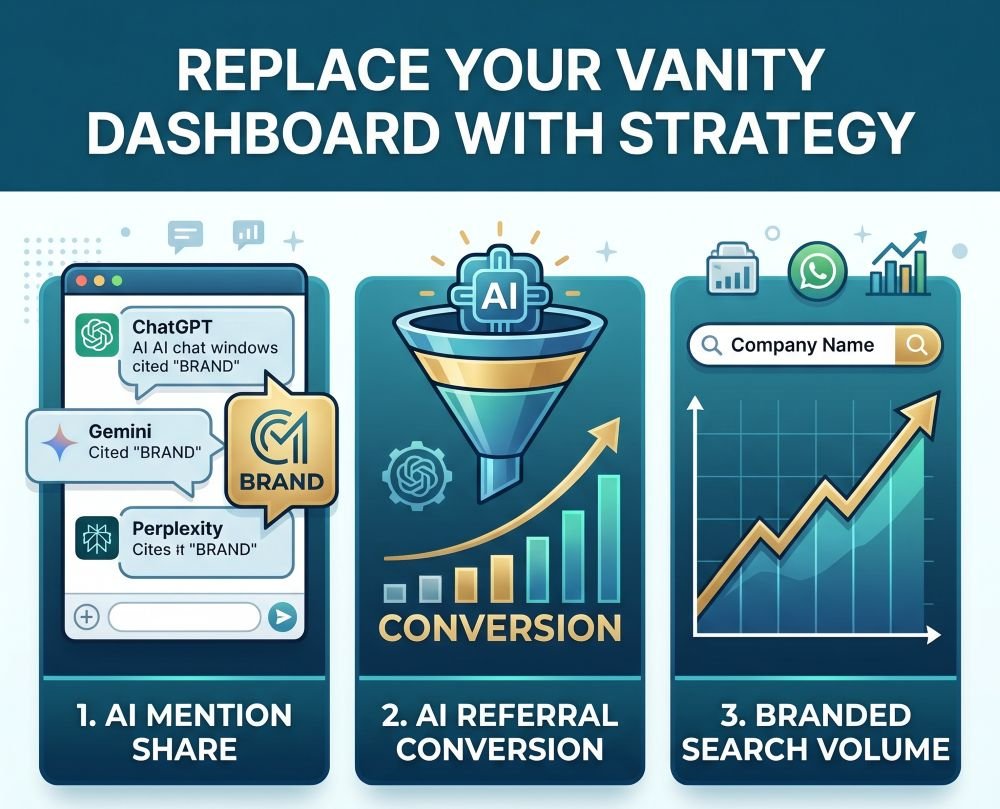
Three numbers earn the spotlight in 2026.
1. AI mention share. How often does ChatGPT, Gemini, or Perplexity cite your brand when a buyer asks a relevant question? Run those queries yourself this week. The gaps you find are your real visibility problem.
2. Conversion rate from AI referrals. The Washington Post reported that visitors arriving from AI platforms subscribed at four to five times the rate of traditional search visitors. Smaller volume. Stronger economics.
3. Branded search volume. When buyers search your company name directly, your brand is winning at the awareness layer. That number tells you whether AI is sending the right people to your door.
These three replace the vanity dashboard. They tell you what is actually working.
Why this shift favors disciplined operators
Here is the part most agencies will not tell you. But this full stack marketing consultancy firm will do 😉 .
AI engines do not reward thin content, keyword stuffing, or volume-first strategies. They reward clarity, authority, and structured expertise.
That means businesses that invested in genuine subject-matter depth are about to pull ahead. The ones that bought traffic with quantity-over-quality content will quietly lose ground.
Generative engines pick sources the way a careful researcher would. They look for original data, defined authorship, and verifiable claims.
If your content meets that bar, you are positioned to win the next five years. If it does not, no amount of new posts will close the gap.
A 90-day reset for marketing leaders
Stop optimizing for a metric that no longer reflects business reality. Start optimizing for qualified pipeline.
Here is the practical sequence.
Audit your AI visibility. Ask ChatGPT, Gemini, and Perplexity the questions your customers ask. Note where you appear and where your competitors do.
Rebuild your measurement frame. Add AI mentions, branded search, and conversion-per-source to your monthly executive report. Retire vanity sessions from the headline view.
Tighten your top pages. Choose the ten URLs that drive the most pipeline. Strengthen authorship, data, and structure on each one.
Diversify your discovery channels. AI engines frequently cite YouTube, Reddit, LinkedIn, and trusted publications. A pure on-site SEO strategy is no longer enough.
This is not a sprint. It is a system. Companies that build it now will compound visibility for years.
The takeaway for your next leadership meeting
Lower traffic is not the crisis. Outdated reporting is.
The business that wins in AI-mediated search does two things. It measures what actually matters. And it acts on that data early.
If your dashboard still treats sessions as the headline number, you are reading last decade’s scoreboard.
The good news? Very few of your competitors have updated theirs yet. That window will not stay open long.
Want a clear-eyed audit of how your brand shows up in AI search today, and what to do about it? Book a Strategic Consultation and we’ll map the next 90 days together.

I’ve spent the last 14 years figuring out what makes people click, buy, and subscribe. As a full-stack marketer, I’ve handled everything from deep-dive SEO and paid media to high-level creative strategy. I don’t just lead cross-functional teams; I help the team to cut through the noise.